- 32pages
- 14scripts written out in full: eight welcomes by place and six closings and toasts
- 25scripts to adapt: speaker introductions, open-microphone prompts, transitions, memory-table words and time cues
- 12tables and worksheets
- 17checkboxes
How we check
Verified, page by page
- 108automatic checks run on the site before every update
Reviewed by industry professionals.
- Primary sourcesThe speaking pace of 140 words per minute is based on Brysbaert (2019), listed with its DOI at the end; the other times in this book are working estimates.
- Every fact has its sourceEach guide lists the pages it relies on, with links, so you can check any point yourself.
- DatedEach page shows when it was last updated.
What you will be able to do
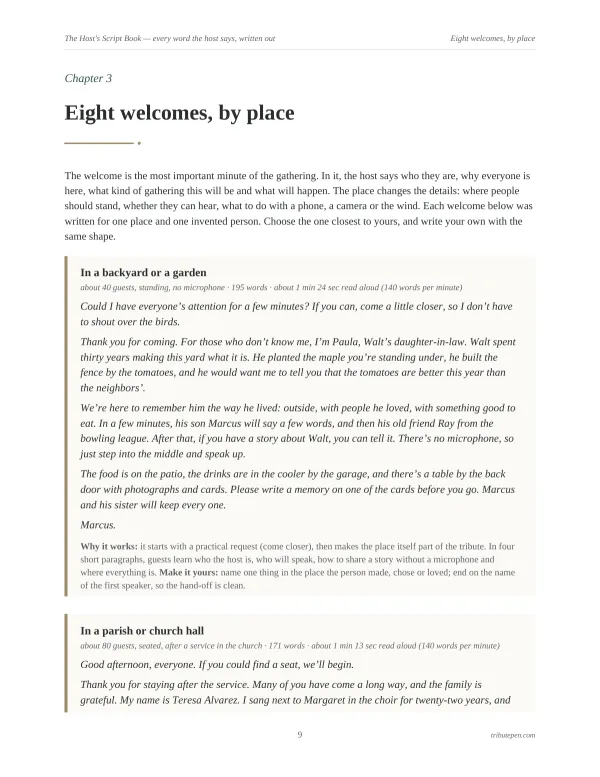
- Open the gathering in under two minutes, with a welcome written for your place: a backyard, a church hall, a restaurant, a beach, a lake, a living room, a video call, or a room with guests online.
- Introduce every speaker in two or three sentences, a son or daughter, a grandchild, an old friend, a colleague, a reader, an officiant, without stealing their stories.
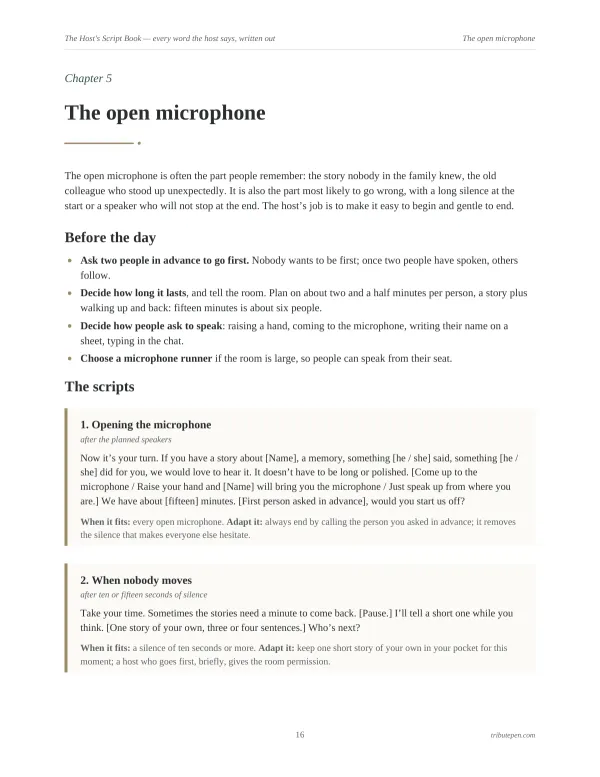
- Run an open microphone that starts and ends well: who goes first, what to say when nobody moves, the prompts that bring stories back, and "two more" before you close.
- Keep the program on time without rushing anyone, with the note to send speakers, a signal, the gentle words for a speaker who goes on too long, and a plan for what can be cut.
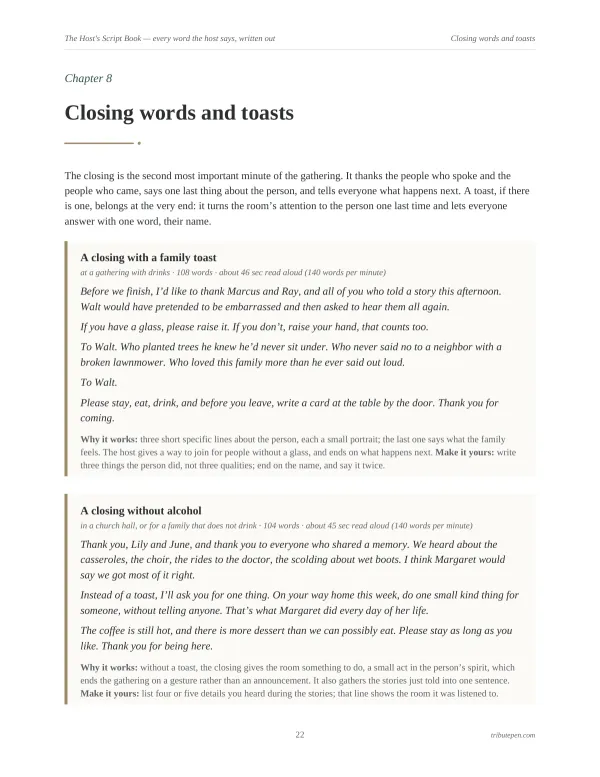
- Close with words and a toast that end on their name, including a closing without alcohol and one for the end of a call.
Who it is for, and who it is not for
For you if you have been asked to host, or to "say a few words and keep things moving," at a celebration of life, a memorial gathering or a reception after a funeral, and you would like every word on a card before the day.
Not for you if you are planning the whole gathering from the start: our Planning a Celebration of Life guide covers the date, the place, the budget and the roles. For free examples first, read our celebration of life speech examples and the order of service page.
What makes it different
A host does not speak once or twice. Over an afternoon, they may stand up a dozen times, and the hardest moments are the small ones: the silence after "Who has a story?", the speaker on minute nine, the microphone that fails, the voice that breaks. This book writes out each of those moments, times the fourteen complete welcomes, closings and toasts, and ends with cards to print, so that on the day you only have to read the next one.
The complete table of contents
The real table of contents of the guide, with its page numbers.
- Before you startp. 5What is in this book · How to use it · What this book is not
- The host’s jobp. 7What the host is responsible for · What the host can hand to someone else · Host and family: who decides what · Your voice, and the moment it breaks · The cards
- Eight welcomes, by placep. 9Write your own welcome
- Introducing each speakerp. 14
- The open microphonep. 16Before the day · The scripts
- Transitions and the memory tablep. 18
- Keeping timep. 20Plan with numbers · The note to the speakers · The signal · What can move, what cannot
- Closing words and toastsp. 22Write your own closing
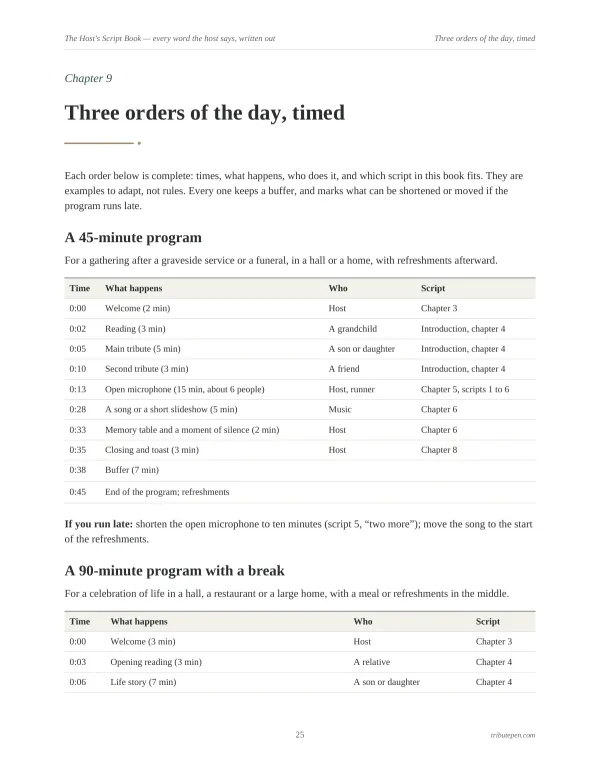
- Three orders of the day, timedp. 25A 45-minute program · A 90-minute program with a break · A whole afternoon · Make it your own
- When something goes wrongp. 28In the room · Outdoors · Online
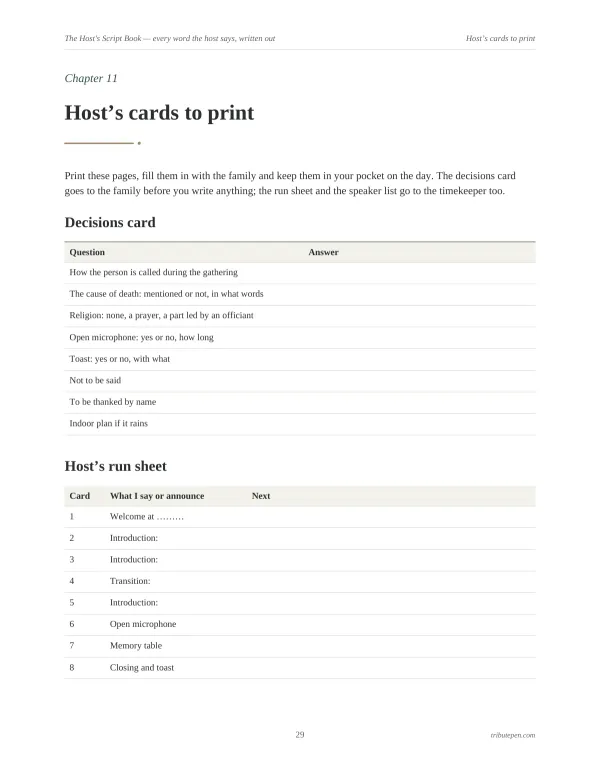
- Host’s cards to printp. 29Decisions card · Host’s run sheet · Speaker list · Open microphone sign-up sheet · Helpers card · The day before · Notes
- Sourcesp. 32
A look inside: real pages of the guide
In pictures

Illustrative photos, published by their authors under free licences.
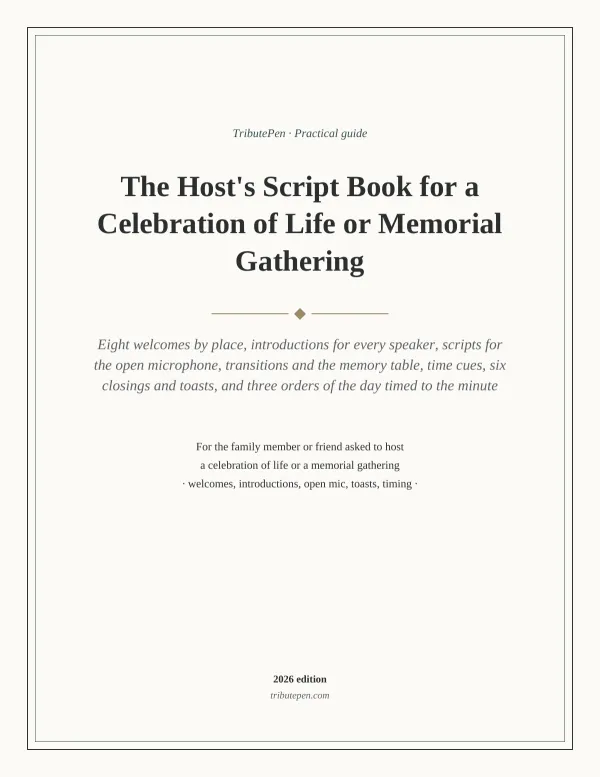
The script book for the person asked to host a celebration of life or a memorial gathering: eight welcomes written out in full for the place (a garden, a church hall, a restaurant, a beach, a lake, a living room, online, a room with guests on video), introductions for every kind of speaker, six scripts for the open microphone, transitions and words for the memory table, the note and the signal that keep speakers on time, six closings and toasts, three orders of the day timed to the minute (45 minutes, 90 minutes, an afternoon), lines for the moments that go wrong and host's cards to print. The eight welcomes and the six closings and toasts carry their word count and their time aloud at 140 words per minute; the templates to adapt have no time.
Pay $29 and receive my PDF script bookBy paying, you accept the Terms.One-time payment by Stripe · Apple Pay · Google Pay · PDF to download right away, link also emailed
Full refund within 14 days, no reason needed · refund policy
Secure payment by Stripe · Apple Pay · Google Pay · no account, no subscription · Questions? Email us
- Secure payment on StripeCard or Apple Pay on Stripe's secure page. Your card number never reaches our servers.
- One price, taxes includedA one-time payment. No account to create, no subscription.
- Yours right after paymentDownload the PDF at once; the link is also emailed to you, and Find my purchases sends it again.
- Full refund within 14 daysWrite to us within 14 days of your purchase and we refund you in full, no reason needed (see the refund policy).
Common questions
How is this different from the Planning a Celebration of Life guide?
The planning guide covers the decisions, the date, the place, the budget, the six-week timeline and the day itself, with one welcome and one toast as examples. This book is only about what the host says out loud. It writes out eight welcomes for different places, introductions for eight kinds of speaker, six open-microphone scripts, eight transitions, the time cues and six closings and toasts, and gives three timed orders of the day and a blank run sheet to fill in.
How long are the welcomes and the toasts?
The welcomes run from under a minute to about a minute and a half read aloud, and the closings and toasts from a few lines to under a minute. The word count and the time are printed under each of these fourteen complete texts, calculated at 140 words per minute, a calm pace with pauses. The templates to adapt (introductions, open-microphone lines, transitions, time cues) have no time printed, since their length depends on the names and details you add.
Does it work for an online or hybrid gathering?
Yes. One welcome is written for a video call and one for a room with guests also joining by video, one closing is for the end of a call, and the chapter on what can go wrong covers sound that fails, microphones left on and disruptions online.
Is there anything for a religious service?
The book is for the gathering the host leads. If a minister, priest, rabbi or celebrant leads part of it, their order comes first; one introduction is written for handing over to them, and one welcome follows a service in the church.
Does it write my eulogy?
No. It writes the host's part, and you adapt it in your own words. If you also give the main tribute, our Writing and Delivering a Eulogy guide covers it, and if you would rather have the speeches written from your own memories, that is the Celebration of Life Kit on TributePen, a separate product.