- 33pages
- 16annotated examples: six eulogies for a parent, each in a full and a short version, and four obituaries
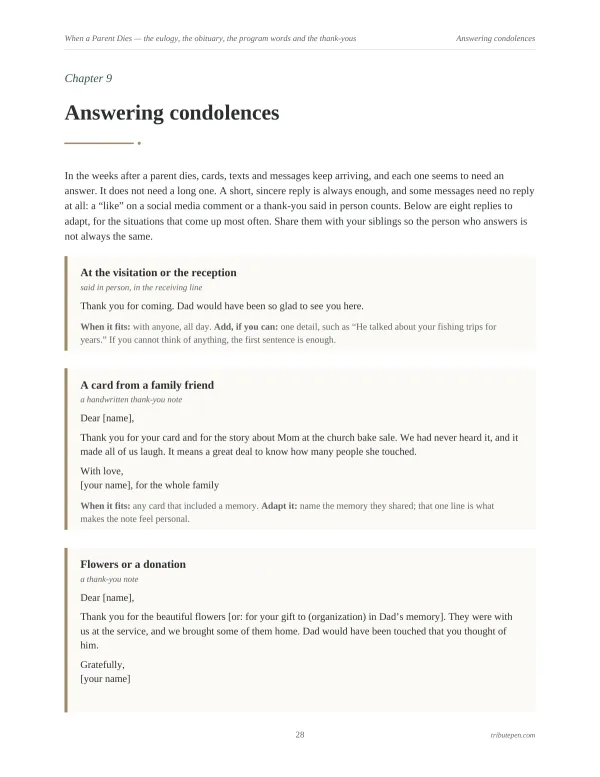
- 8replies to condolences, for cards, texts, social media and the receiving line
- 12tables and worksheets
- 17checkboxes
How we check
Verified, page by page
- 108automatic checks run on the site before every update
- 2official .gov pages read and cited, on November 3, 2026
Reviewed by industry professionals.
- Primary sourcesThis guide is built from the guidance of the Internal Revenue Service and the Federal Trade Commission.
- Every fact has its sourceEach guide lists the pages it relies on, with links, so you can check any point yourself.
- DatedSources read on November 3, 2026; each page shows when it was last updated.
What you will be able to do
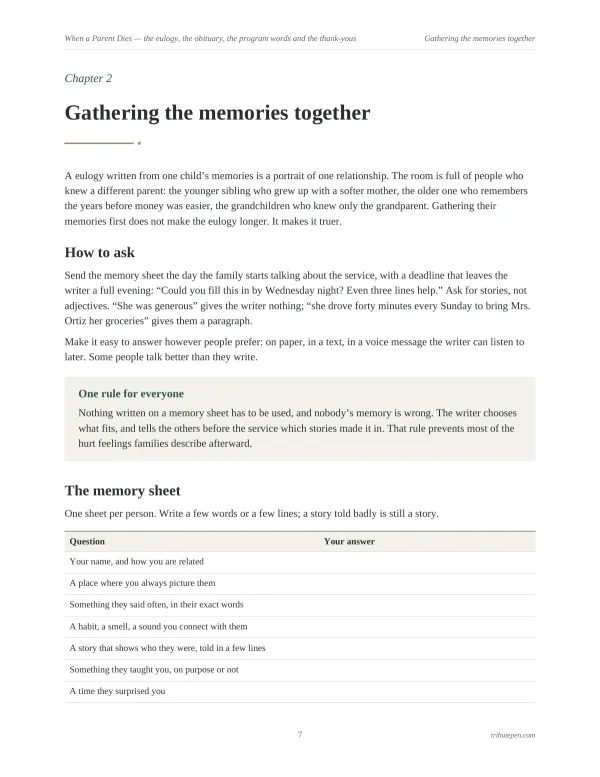
- Gather everyone's memories before anyone writes, with a memory sheet for each brother or sister and the questions only an older sibling or an aunt can answer.
- Decide once, in writing, who writes what: the eulogy, the obituary, the death announcement, the program words, the replies to cards, and who has the last word when you disagree.
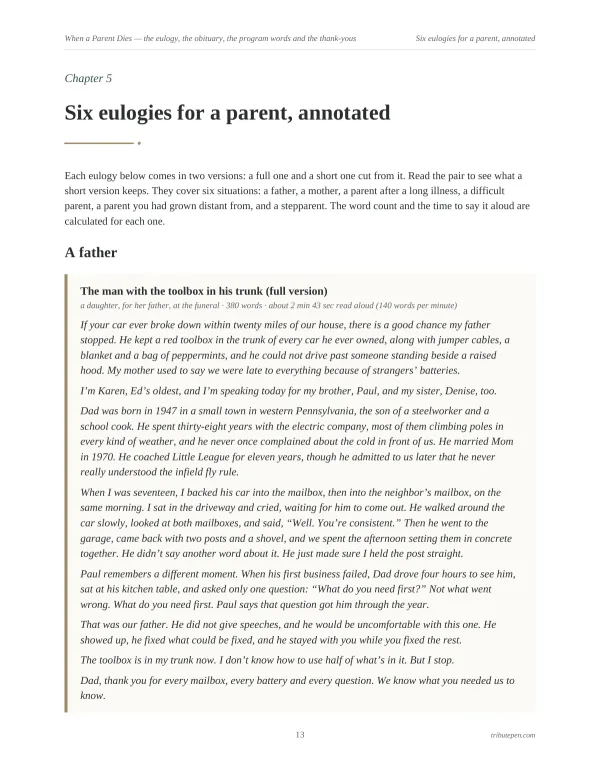
- Write a eulogy for your father or mother in two lengths, a full one and a short one ready in case the service runs late or your voice will not hold, following six complete examples.
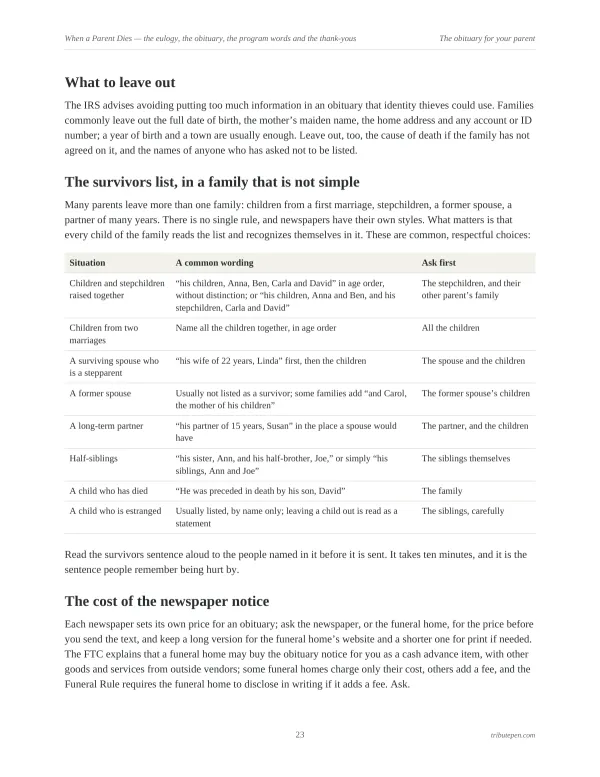
- Write the obituary with the facts checked and the survivors named in a way the whole family recognizes, stepchildren and former spouses included, and know what to leave out.
- Answer the cards, texts and comments that keep arriving, with replies to share among the siblings and a tracker so no one is forgotten.
Who it is for, and who it is not for
For you if your father, your mother or a stepparent has died and the writing has landed on you, whether you share it with siblings or carry it alone.
Not for you if you only need a eulogy method for any relationship: our Writing and Delivering a Eulogy guide covers every relationship and the delivery in detail. For free examples first, start with our pages on a eulogy for dad and a eulogy for mom.
What makes it different
Most eulogy guides are written for one speaker. When a parent dies, there are usually several children, one writer, and a family that has to agree on a speech, an obituary and a survivors list in a few days. This workbook starts from that: the memories of every sibling, the decisions written down before anyone is hurt, and examples for the parents that are hardest to write about, the difficult one, the distant one and the stepparent.
The complete table of contents
The real table of contents of the guide, with its page numbers.
- Before you startp. 5What you will have when you finish · How to use it · If you are doing this alone
- Gathering the memories togetherp. 7How to ask · The memory sheet · Questions only some of you can answer · Choosing what to keep
- Who writes whatp. 9The split · How long each speaker talks · When you disagree
- Writing the eulogy for your parentp. 11The structure, in five parts · Two lengths, one eulogy · Speaking for your siblings · Before you say it
- Six eulogies for a parent, annotatedp. 13A father · A mother · A parent after a long illness · A difficult parent · A parent you had grown distant from · A stepparent
- The obituary for your parentp. 22The facts first · What to leave out · The survivors list, in a family that is not simple · The cost of the newspaper notice
- Four obituaries for a parentp. 24
- Words for the programp. 26The cover · Inside: the order of service · The back page: a word from the family
- Answering condolencesp. 28
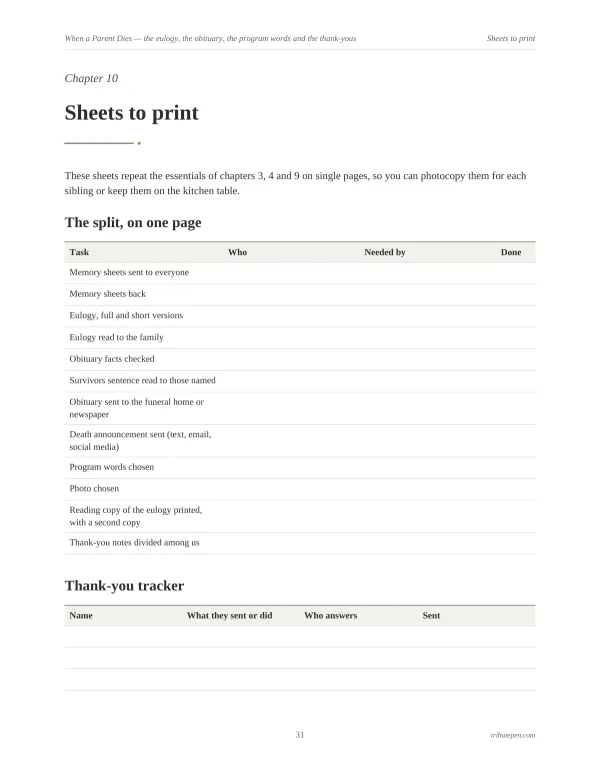
- Sheets to printp. 31The split, on one page · Thank-you tracker · Reading copy checklist · Notes
- Sourcesp. 33
A look inside: real pages of the guide
In pictures



Illustrative photos, published by their authors under free licences.
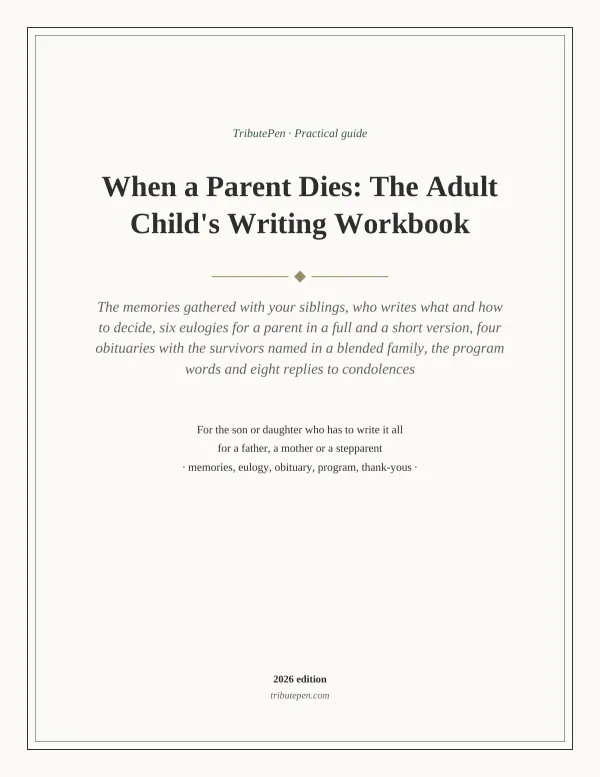
The workbook for the son or daughter who has to write everything for a father or a mother: a memory sheet for each sibling, a written split of who writes the eulogy, the obituary, the program words and the thank-yous, rules for deciding when you disagree, six complete eulogies for a parent (a father, a mother, after a long illness, a difficult parent, an estranged parent, a stepparent), each in a full and a short version, four obituaries with the survivors named in blended families, words for the program, eight replies to condolences and sheets to print.
Pay $39 and receive my PDF workbookBy paying, you accept the Terms.One-time payment by Stripe · Apple Pay · Google Pay · PDF to download right away, link also emailed
Full refund within 14 days, no reason needed · refund policy
Secure payment by Stripe · Apple Pay · Google Pay · no account, no subscription · Questions? Email us
- Secure payment on StripeCard or Apple Pay on Stripe's secure page. Your card number never reaches our servers.
- One price, taxes includedA one-time payment. No account to create, no subscription.
- Yours right after paymentDownload the PDF at once; the link is also emailed to you, and Find my purchases sends it again.
- Full refund within 14 daysWrite to us within 14 days of your purchase and we refund you in full, no reason needed (see the refund policy).
Common questions
What does "two lengths" mean for the eulogies?
Each of the six eulogies comes as a full version, of two to three minutes read aloud, and a short version cut from it, of about a minute, with a note on what was cut and what was kept. The word count and the time are printed under each one, at 140 words per minute. Services run late and some speakers can manage only a minute on the day, so chapter 4 asks you to keep both versions of your own eulogy on paper.
My parent was difficult, or we had not spoken in years. Is there anything for that?
Yes. Two of the six eulogies are for those situations, a mother who was hard to live with and a father the speaker had not seen in six years. Each says the difficulty once, in a sentence or two, and then stays with what was true. Chapter 3 also has you agree, in writing, on how the hard subjects are mentioned before anyone writes.
How does it handle stepparents, half-siblings and former spouses?
One eulogy is by a stepdaughter for her stepfather. Chapter 6 has a table of common, respectful wordings for the survivors list, from children and stepchildren raised together to a former spouse, a long-term partner, half-siblings and an estranged child, with whom to ask before the obituary is sent. One of the four obituaries is for a father in a blended family.
I have no brothers or sisters. Is it still useful?
Yes. The split of tasks in chapter 3 becomes your own order of work, and the workbook suggests asking one cousin, aunt or family friend to fill in a memory sheet. Everything else, the eulogies, the obituary, the program words and the replies, is the same.
Does it write the eulogy for me?
No. It gives you the method, the sheets and complete examples to lean on, and you write in your own words. If you would rather have a first draft written from your memories, that is the personalized eulogy on TributePen, a separate product.
Sources cited in the guide
- Internal Revenue Service, "Identity theft guide for individuals" (last reviewed or updated November 2, 2026), read on November 3, 2026.
- Federal Trade Commission, Consumer Advice, "Funeral Costs and Pricing Checklist", read on November 3, 2026.