- 37pages
- 120original interview questions to choose from
- 4filled-in examples: interview notes, a eulogy plan and checked obituary facts
- 12scripts to adapt: asking for a memory, asking to record, opening and closing an interview, when someone cries
- 16tables and worksheets
- 34checkboxes
How we check
Verified, page by page
- 116automatic checks run on the site before every update
- 2official .gov pages read and cited, on November 6, 2026
Reviewed by industry professionals.
- Primary sourcesThis guide is built from the guidance of the Library of Congress and the Internal Revenue Service.
- Every fact has its sourceEach guide lists the pages it relies on, with links, so you can check any point yourself.
- DatedSources read on November 6, 2026; each page shows when it was last updated.
What you will be able to do
- Know whom to ask, and in what order, with a map of the people who knew each part of their life and the three to five interviews that are enough.
- Ask a grieving relative for a memory with words that say what you are writing, how long it takes, and that no is fine, including for an older relative, someone outside the family and a group of friends or coworkers.
- Run a short interview people are glad they gave: the length, the place, asking to record, the opening words, the silences, what to say when someone cries, and how to close.
- Choose your questions in minutes from 120 numbered questions and the interview guide for your relationship.
- Settle what does not match and check every name, date and survivor before anything is read aloud or printed.
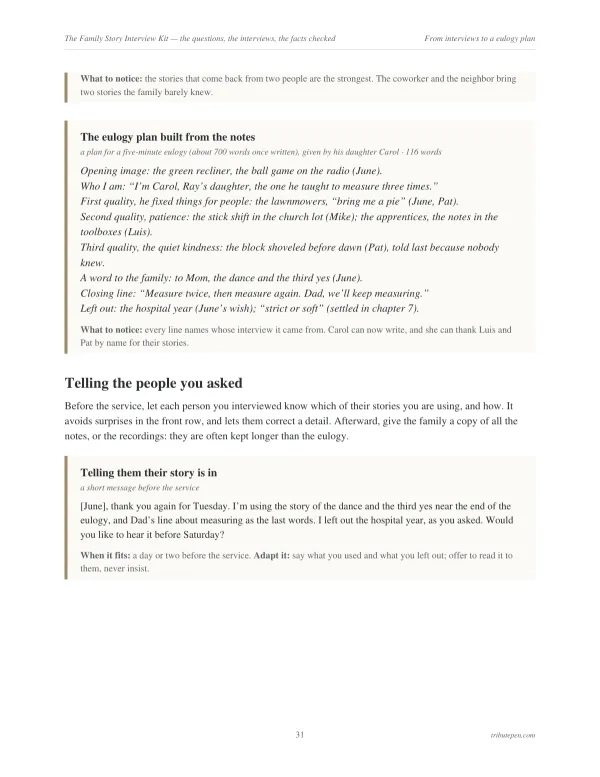
- Turn your notes into a plan: the eulogy plan with whose story goes where, and the obituary facts with their sources.
Who it is for, and who it is not for
For you if you have been asked to write the eulogy for your father, your mother, your brother or anyone you loved, or to fill in the obituary, and you want the stories and the facts from the people who knew them before you start.
Not for you if you already have the material and need finished examples: our Writing and Delivering a Eulogy guide and our obituary workbook are written for that step. For a free start, our fill-in-the-blank obituary template assembles the sentences once you have the facts, and our page on a eulogy for a dad has a complete example.
What makes it different
Most eulogy and obituary advice starts at the blank page. This kit starts one step earlier, with the people who hold the stories. It treats the interview as something you do for a grieving family, not to them: short, with permission, with an easy no. And it does not stop at the stories. The reconciliation table and the fact sheet are there so that a granddaughter's name is spelled right in print and nobody in the front row hears a date they know is wrong.
The complete table of contents
The real table of contents of the guide, with its page numbers.
- Before you startp. 6What you will have when you finish · How to use it · Why ask other people at all
- Who to interview, and in what orderp. 8Mapping the people · How many people, and who first · When to ask · In person, by phone, by video, or in writing
- Asking for a memoryp. 10Five things every request says
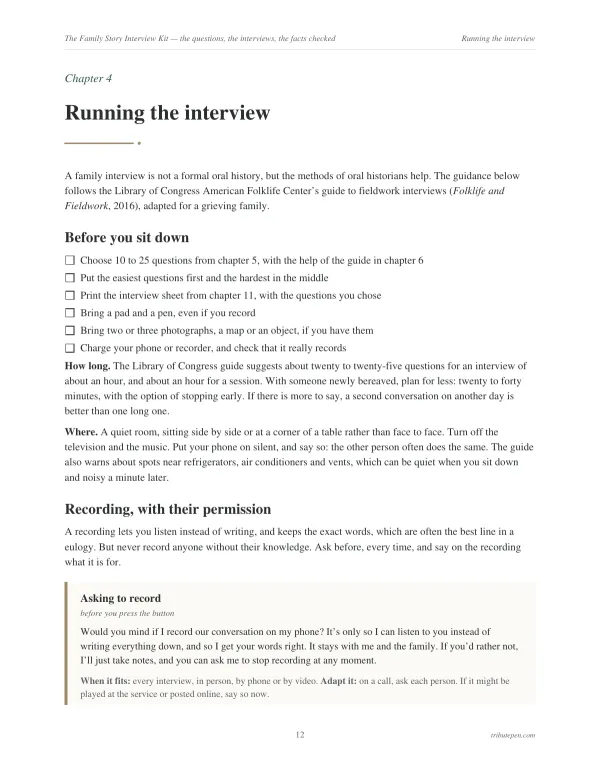
- Running the interviewp. 12Before you sit down · Recording, with their permission · Asking, listening, and the silences · Follow-up questions that work · Photographs and objects · When someone cries, or goes quiet · Closing the interview · Within the hour after
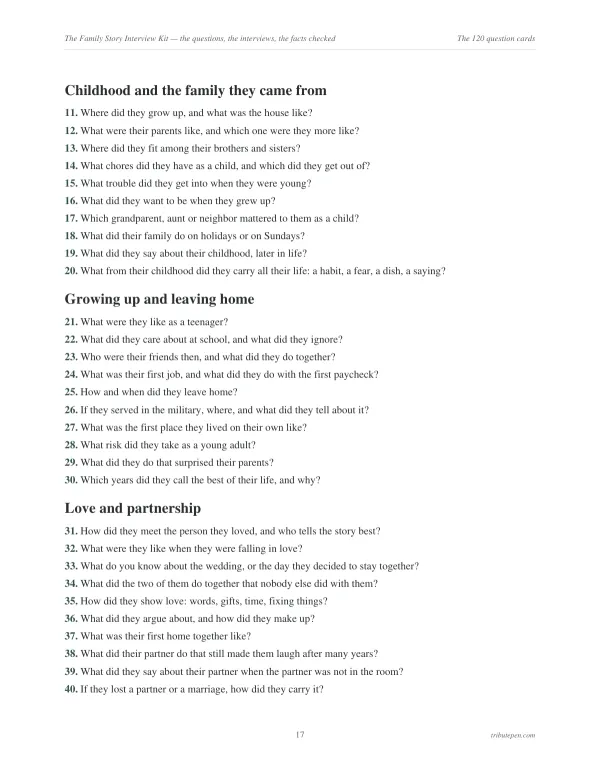
- The 120 question cardsp. 16Easy beginnings · Childhood and the family they came from · Growing up and leaving home · Love and partnership · Children, grandchildren, the family they made · Work and what they were good at · Friends, community and faith · The everyday: home, food, habits, sayings · Character: humor, temper and heart · Hard times, and how they met them · The later years and the last chapter · Closing questions
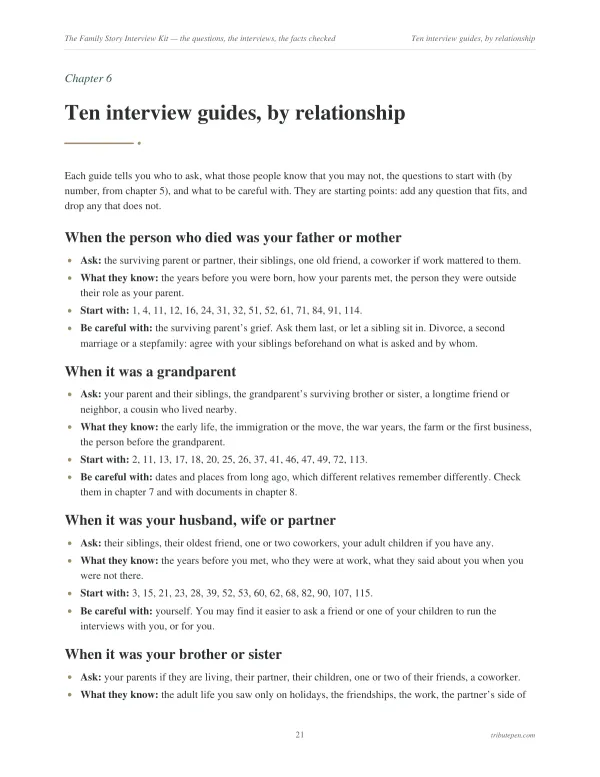
- Ten interview guides, by relationshipp. 21When the person who died was your father or mother · When it was a grandparent · When it was your husband, wife or partner · When it was your brother or sister · When it was a friend · When it was a coworker or business partner · When it was your son or daughter · When it was an aunt, uncle or cousin · When they lived a very long life · When you barely knew them
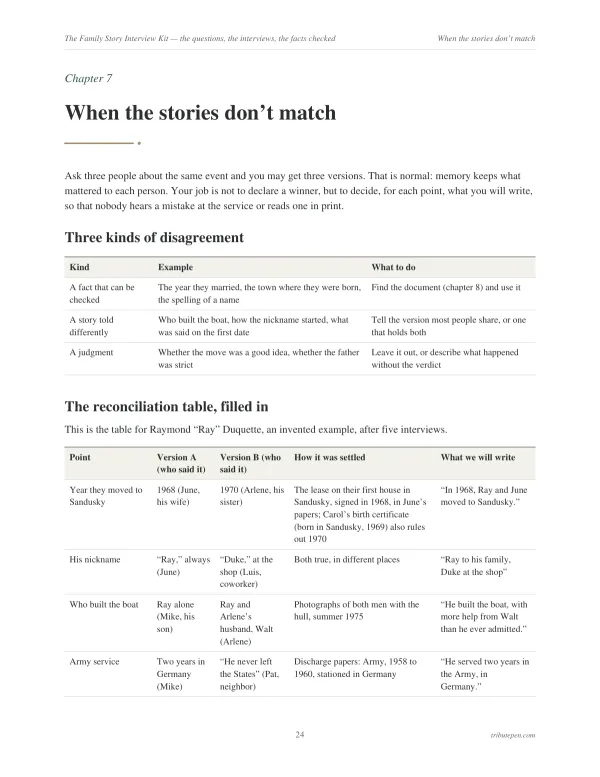
- When the stories don’t matchp. 24Three kinds of disagreement · The reconciliation table, filled in · Words that hold two versions · Rules for the hard cases
- Checking the factsp. 26Where to check · The fact sheet · Survivors, name by name · What not to put in print
- From interviews to a eulogy planp. 29Reading your notes · How long, and how much material · The eulogy plan · A worked example: five interviews, one plan · Telling the people you asked
- From interviews to an obituaryp. 32Which facts go where · A worked example: from the fact sheet to the obituary plan · Before the obituary goes out
- Sheets to printp. 34The interview sheet · Names, dates and places mentioned · The interview plan · Reconciliation table, blank · Before each interview · Notes
- Sourcesp. 37
A look inside: real pages of the guide
In pictures


Illustrative photos, published by their authors under free licences.
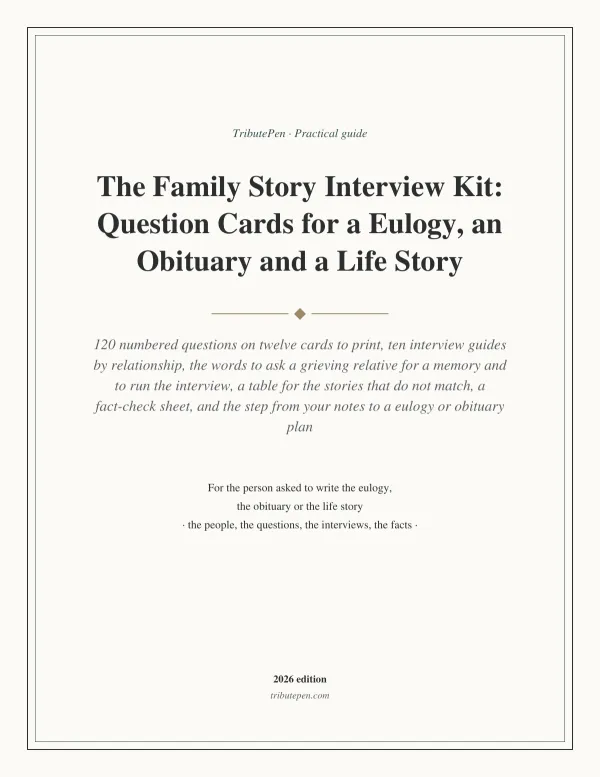
The kit for gathering the facts and the stories from the people who knew them, before you write the eulogy, the obituary or a life story: whom to ask and in what order, the words to ask a grieving relative for a memory, how to run and record an interview with permission (length, opening words, silences, tears), 120 original questions numbered in twelve themes to print as cards, ten interview guides by relationship, a table to settle the versions that do not match, a fact-check sheet for names, dates, survivors and places, and the step from your notes to a eulogy plan or an obituary plan.
Pay $29 and receive my PDF kitBy paying, you accept the Terms.One-time payment by Stripe · Apple Pay · Google Pay · PDF to download right away, link also emailed
Full refund within 14 days, no reason needed · refund policy
Secure payment by Stripe · Apple Pay · Google Pay · no account, no subscription · Questions? Email us
- Secure payment on StripeCard or Apple Pay on Stripe's secure page. Your card number never reaches our servers.
- One price, taxes includedA one-time payment. No account to create, no subscription.
- Yours right after paymentDownload the PDF at once; the link is also emailed to you, and Find my purchases sends it again.
- Full refund within 14 daysWrite to us within 14 days of your purchase and we refund you in full, no reason needed (see the refund policy).
Common questions
What are the 120 questions about?
They are open questions, numbered and sorted into twelve themes of ten, from easy beginnings to closing questions, through childhood, growing up, love and partnership, children and grandchildren, work, friends and faith, everyday habits and sayings, character, hard times and the later years. Each theme fills one card you can print on card stock and cut out. None can be answered with a plain yes or no.
Which relationships do the ten interview guides cover?
A father or mother, a grandparent, a husband, wife or partner, a brother or sister, a friend, a coworker or business partner, a son or daughter, an aunt, uncle or cousin, a person who lived a very long life, and a person you barely knew. Each guide says whom to ask, what those people know, the fifteen numbered questions to start with, and what to be careful with.
Do I have to record the interviews?
No. Notes work, and the kit has an interview sheet for them. If you do record, chapter 4 gives you the words to ask permission first, the opening words to say on the recording, and how to keep your word if someone asks for something to stay out. The interview method follows the Library of Congress American Folklife Center's guide to fieldwork interviews, adapted for a grieving family.
What if relatives tell the same story differently?
Chapter 7 sorts the disagreements into facts you can check, stories told differently and judgments, with a reconciliation table filled in for an invented family and words that let two versions be true. Chapter 8 lists where to check each fact, with a fact sheet and a survivors table to fill in name by name.
Does it write the eulogy or the obituary?
No. It gathers the material and ends with a eulogy plan and an obituary plan, with a worked example from five interviews. There are no finished eulogies in it. If you would rather have a first draft written from your answers, that is the personalized eulogy or obituary on TributePen, a separate product.
Sources cited in the guide
- Library of Congress, American Folklife Center, "Folklife and Fieldwork: An Introduction to Cultural Documentation" (fourth edition, 2016), read on November 6, 2026.
- Internal Revenue Service, "Identity theft guide for individuals" (last reviewed or updated November 2, 2026), read on November 6, 2026.
- Brysbaert M. (2019). How many words do we read per minute? A review and meta-analysis of reading rate. Journal of Memory and Language, 109, 104047.