- 41pages
- 30complete condolence letters of about 125 to 165 words, each with a note on when it fits
- 9layouts and replies to adapt: the page, the envelope, a note with a photo, answers to the letters you receive
- 11tables and worksheets
- 12checkboxes
How we check
Verified, page by page
- 116automatic checks run on the site before every update
Reviewed by industry professionals.
- Primary sourcesThe envelope rules follow the U.S. Postal Service's own guidance; the one study cited, on expressive writing (Pennebaker, 1997), is listed with its DOI at the end. The thirty letters are written for this book.
- Every fact has its sourceEach guide lists the pages it relies on, with links, so you can check any point yourself.
- DatedEach page shows when it was last updated.
What you will be able to do
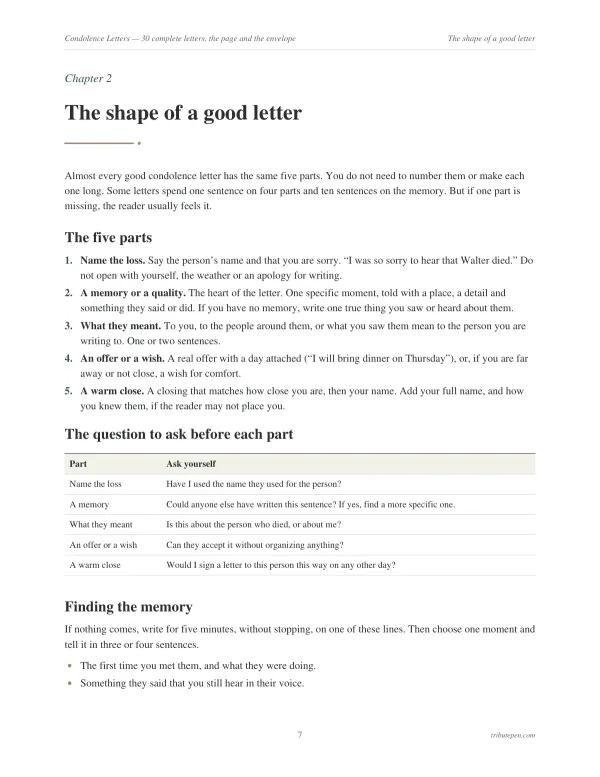
- Write the five parts of a good letter: name the loss, one memory, what they meant, an offer they can accept, a warm close.
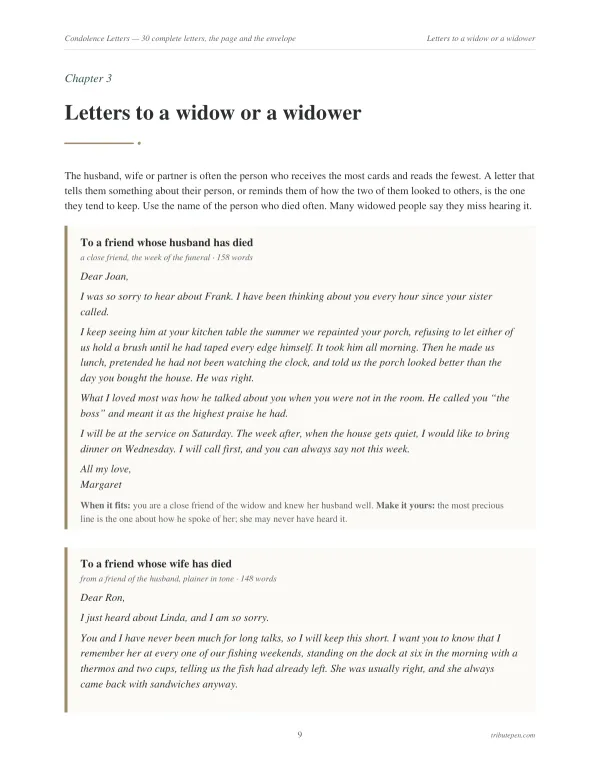
- Start from a complete letter close to your situation, among thirty, and replace every detail with your own.
- Find the memory when nothing comes, and make an offer with a day attached instead of "let me know if you need anything."
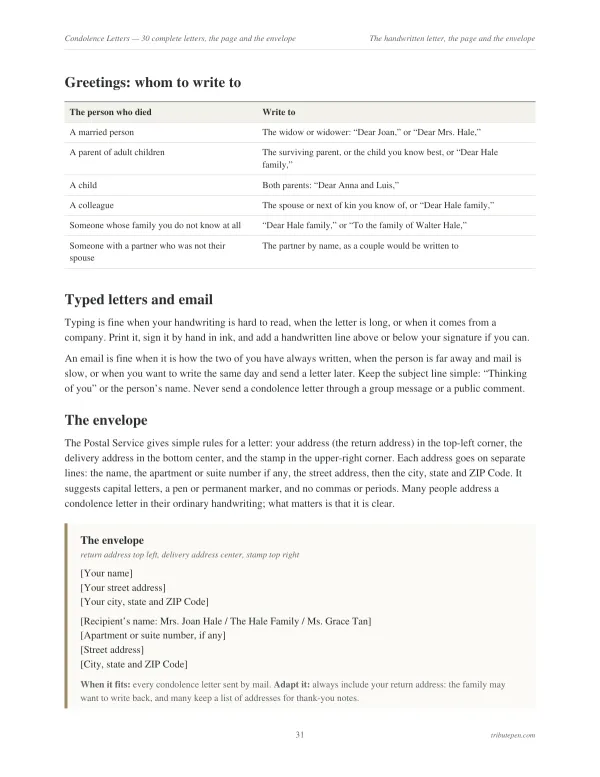
- Lay out the page and address the envelope by hand, with the right greeting and closing for how close you are.
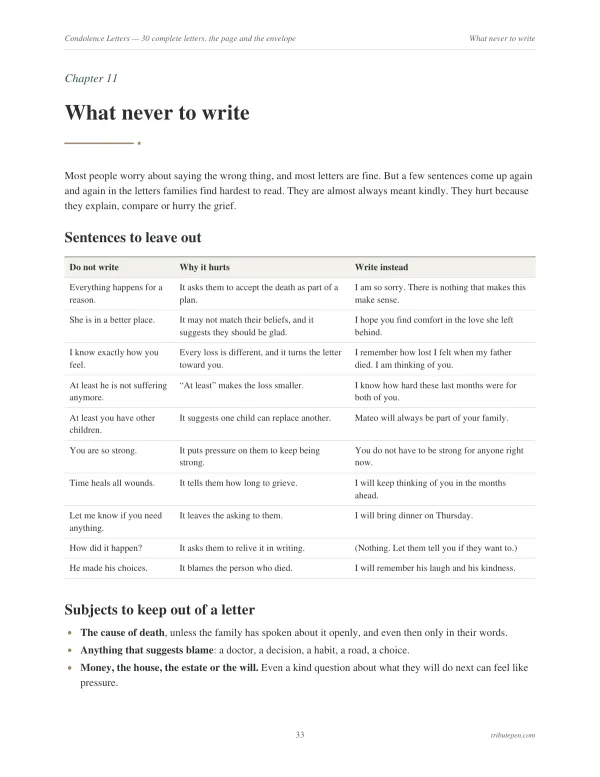
- Leave out the sentences that hurt, with what to write instead.
- Answer the letters you received, if you are the family, with six short replies.
Who it is for, and who it is not for
For you if you want to write more than a line: to a close friend whose husband or wife has died, to a colleague who lost a parent, to parents who lost a child, to the family of a teacher or a client, or on behalf of your team at work.
Not for you if you only need a line or two for a card: our sympathy card wording book has 200 short messages. For a free start, our page on how to write a condolence letter has the five parts and four complete letters, and our sympathy messages for the loss of a spouse has short wording for a widow or widower.
What makes it different
Most condolence advice gives you lines to copy. This book gives you whole letters, from "Dear" to the signature, for the situations people find hardest to write: a baby who died, a suicide, a letter months late, a letter from a company that sounds like a person. Each one comes with a note on when it fits and how to make it yours, because a letter is kept for the one memory only you could have written.
The complete table of contents
The real table of contents of the guide, with its page numbers.
- Before you writep. 5What you will have when you finish · How to use it · Why a letter, and why by hand · Card, letter or both
- The shape of a good letterp. 7The five parts · The question to ask before each part · Finding the memory · Making an offer they can accept · Openings and closings by how close you are · How long
- Letters to a widow or a widowerp. 9
- Letters to a son or daughter who lost a parentp. 12
- Letters to parents who have lost a childp. 15
- Letters when you knew the family less wellp. 18
- Letters after a sudden deathp. 21
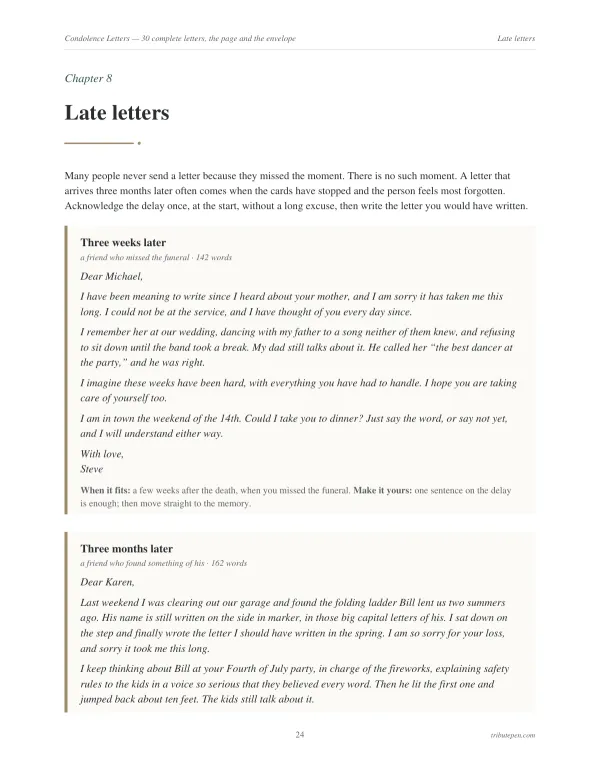
- Late lettersp. 24
- Letters from a team or a companyp. 27
- The handwritten letter, the page and the envelopep. 30Paper and ink · The layout of the page · Greetings: whom to write to · Typed letters and email · The envelope · What to put in the envelope
- What never to writep. 33Sentences to leave out · Subjects to keep out of a letter · A short check before you seal it
- Answering a letter you receivedp. 35When and how to answer
- Sending sheetp. 38Letters to write · Draft your letter · Offers I made · Dates to write again
- Sourcesp. 41
A look inside: real pages of the guide
In pictures



Illustrative photos, published by their authors under free licences.
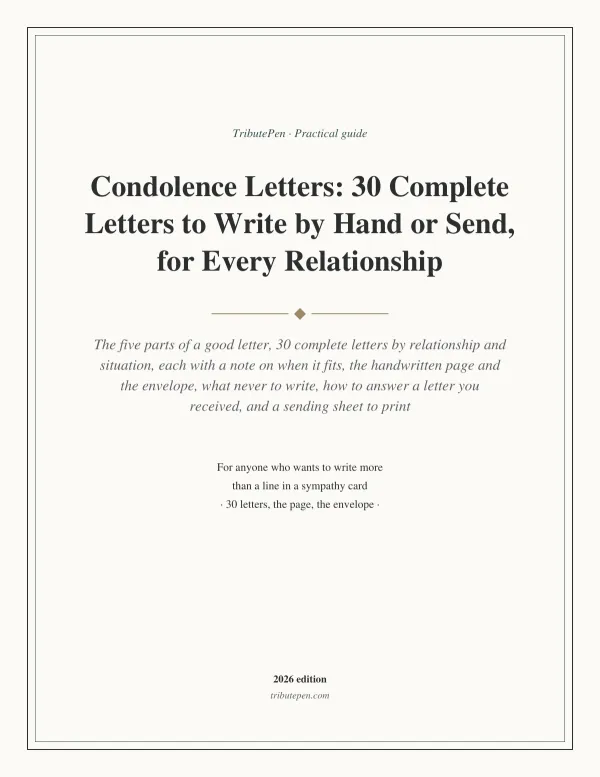
The book for writing a real condolence letter instead of a line in a card: the five parts of a good letter, 30 complete letters of about 125 to 165 words (to a widow or widower, to a son or daughter who lost a parent, to parents who lost a child, to a family you barely know, after a sudden death, a late letter, a letter from a team or a company to the family of an employee), each with a note on when it fits, the layout of a handwritten page, how to address the envelope, what never to write, how to answer a letter you received, and a sending sheet to print.
Pay $29 and receive my PDF letter bookBy paying, you accept the Terms.One-time payment by Stripe · Apple Pay · Google Pay · PDF to download right away, link also emailed
Full refund within 14 days, no reason needed · refund policy
Secure payment by Stripe · Apple Pay · Google Pay · no account, no subscription · Questions? Email us
- Secure payment on StripeCard or Apple Pay on Stripe's secure page. Your card number never reaches our servers.
- One price, taxes includedA one-time payment. No account to create, no subscription.
- Yours right after paymentDownload the PDF at once; the link is also emailed to you, and Find my purchases sends it again.
- Full refund within 14 daysWrite to us within 14 days of your purchase and we refund you in full, no reason needed (see the refund policy).
Common questions
Which situations do the 30 letters cover?
Five letters to a widow, a widower or a partner who was not married to the person who died; five to a son or daughter who lost a parent, including after dementia; four to parents who lost a child, from a baby to an adult son; four for a family you knew less well, such as a former teacher's or a client's; four after a sudden death, including an accident and a death by suicide; four late letters, from three weeks to years later; and four from a manager, a team or a company to the family of an employee, or to an employee whose spouse has died.
How long are the letters?
Each letter is complete, from "Dear" to the signature, and runs between about 125 and 165 words, which fits on one side of a sheet of stationery or a folded note card. The word count is printed under each letter's title, and each letter ends with a note on when it fits and how to make it yours.
Is this the same as the sympathy card wording book?
No. What to Write in a Sympathy Card holds 200 short messages for a card and three longer letters. This book is only about letters: thirty complete ones, the shape behind them, the handwritten page and the envelope, what to leave out, and how the family can answer the letters they receive.
Can I send the letter by email or typed?
Yes. Chapter 10 says when a typed or emailed letter is fine, how to sign a typed letter by hand, and how to lay out a handwritten page. The envelope section follows the U.S. Postal Service's own rules for addressing a letter.
Does it write the letter for me?
No. It gives you the shape and thirty examples to adapt with your own memory, which is what makes a letter worth keeping. If you would rather have a short sympathy message written from your own answers, that is the personalized message on TributePen, a separate product.
Sources cited in the guide
- Pennebaker J. W. (1997). Writing About Emotional Experiences as a Therapeutic Process. Psychological Science, 8(3), 162-166.
- U.S. Postal Service, "How to Send a Letter or Postcard", read on November 7, 2026.
- 988 Suicide & Crisis Lifeline, 988lifeline.org, read on November 7, 2026.
Related guides
- How to write a condolence letterThe five parts of a condolence letter, and four complete letters.
- Sympathy messages for the loss of a husband or wifeFor a widow or widower, from the first days to the first year.
- Sympathy messages for the loss of a motherCard messages and longer notes for a friend who lost their mom.